A job title isn't just a line of text on a profile. Competency frameworks, KPIs, mandatory training courses, and staffing plans are all tied to job titles — so if this list is messy, everything downstream will be messy too.
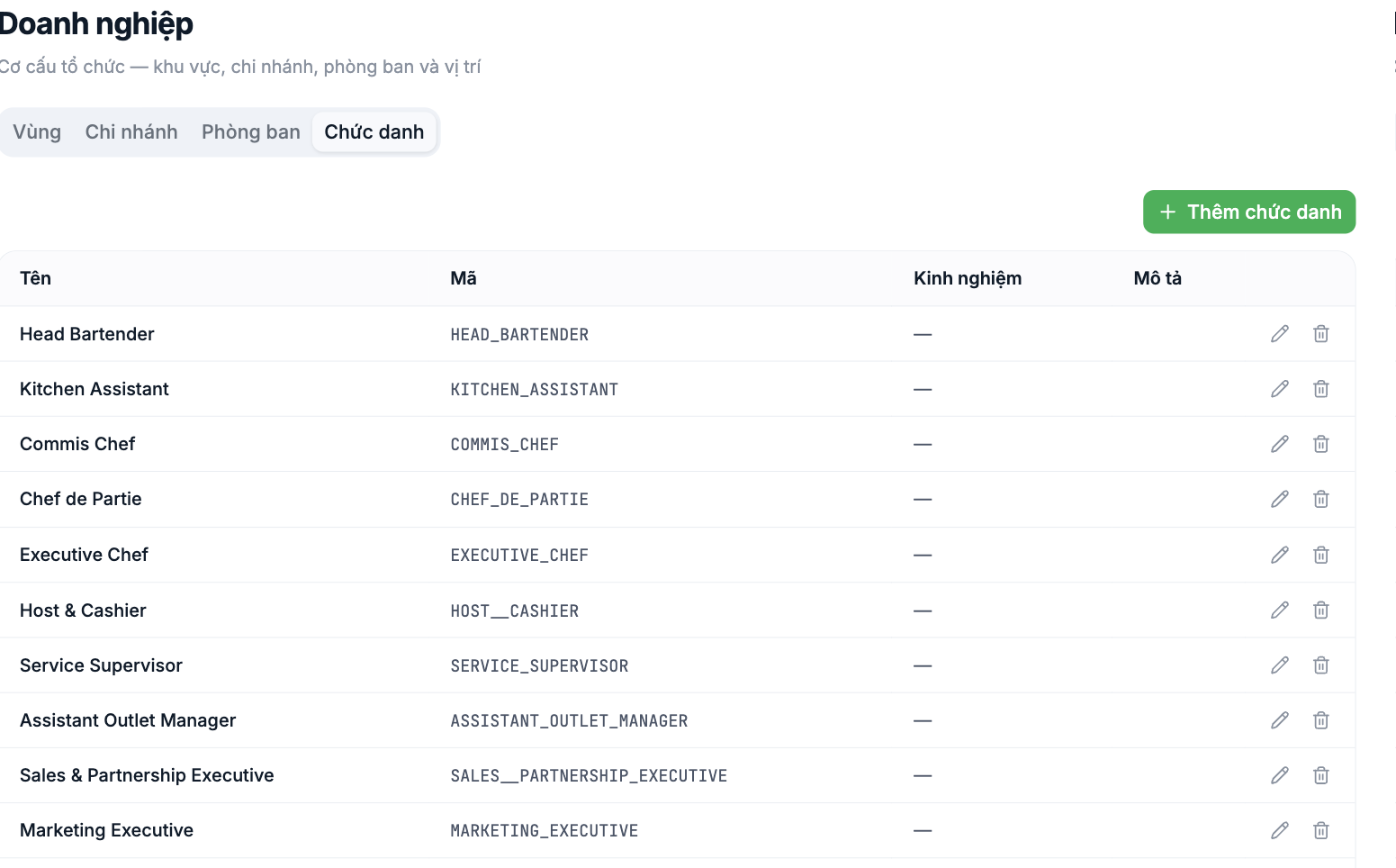
Four fields
| Field | What to enter |
|---|---|
| Name | The name of the position |
| Code | Uppercase, joined with underscores, for example `EXECUTIVE_CHEF` |
| Experience | Required years of experience — used for recruitment and career paths; can be left blank |
| Description | The scope of responsibilities of the position |
Naming conventions
| Rule | Do | Don't |
|---|---|---|
| A single language | All Vietnamese, or all English | Mixing "Bếp trưởng" with "Executive Chef" |
| [Level] + [Profession] structure | Senior Accountant · Kitchen Assistant | Accountant (good) |
| Singular, without the department | Marketing Executive | Marketing Department Staff, Branch 1 |
| Don't include people's names | Operations Manager | Operations Manager – Mr. Nam |
| Codes in uppercase joined with underscores | `EXECUTIVE_CHEF` | `exec chef 01` |
Only set up job titles that are currently held by someone or are planned to be hired within the next 12 months. A list bloated with dozens of dead entries is a very common problem, and it dilutes every report as well as the talent matrix later on.
Job titles are shared company-wide
Job titles are not tied to a specific branch. The same job title can appear in multiple branches and multiple departments. Job titles are assigned to each person in the employee profile, on the Work tab.
Check before importing employees
- Open the most recent month's payroll and cross-check every job title in it against the list you just set up. No entry should be missing.
- Each job title should have only one spelling, with no duplicate variants.
- Record all Region, Branch, Department, and Job Title codes in one place for use when filling in the import file.

