A competency gap is the difference between the actual level and the required level. It's the number that turns review results into a training plan — and the main reason to build a competency system at all.
How the gap is calculated
For each skill of a person: gap = the job title's required level − the actual rated level. The required level is set in step 2 of the competency framework (article B13-05); the actual level comes from the review cycle (article B13-06).
| Gap | Read as |
|---|---|
| 0 or negative | Meets or exceeds requirements. No training needed |
| 1 level | Moderate shortfall. On-the-job coaching is usually enough |
| 2 levels or more | Significant shortfall. Needs a structured training course, or a review of whether this person is in the right position |
Where to view it
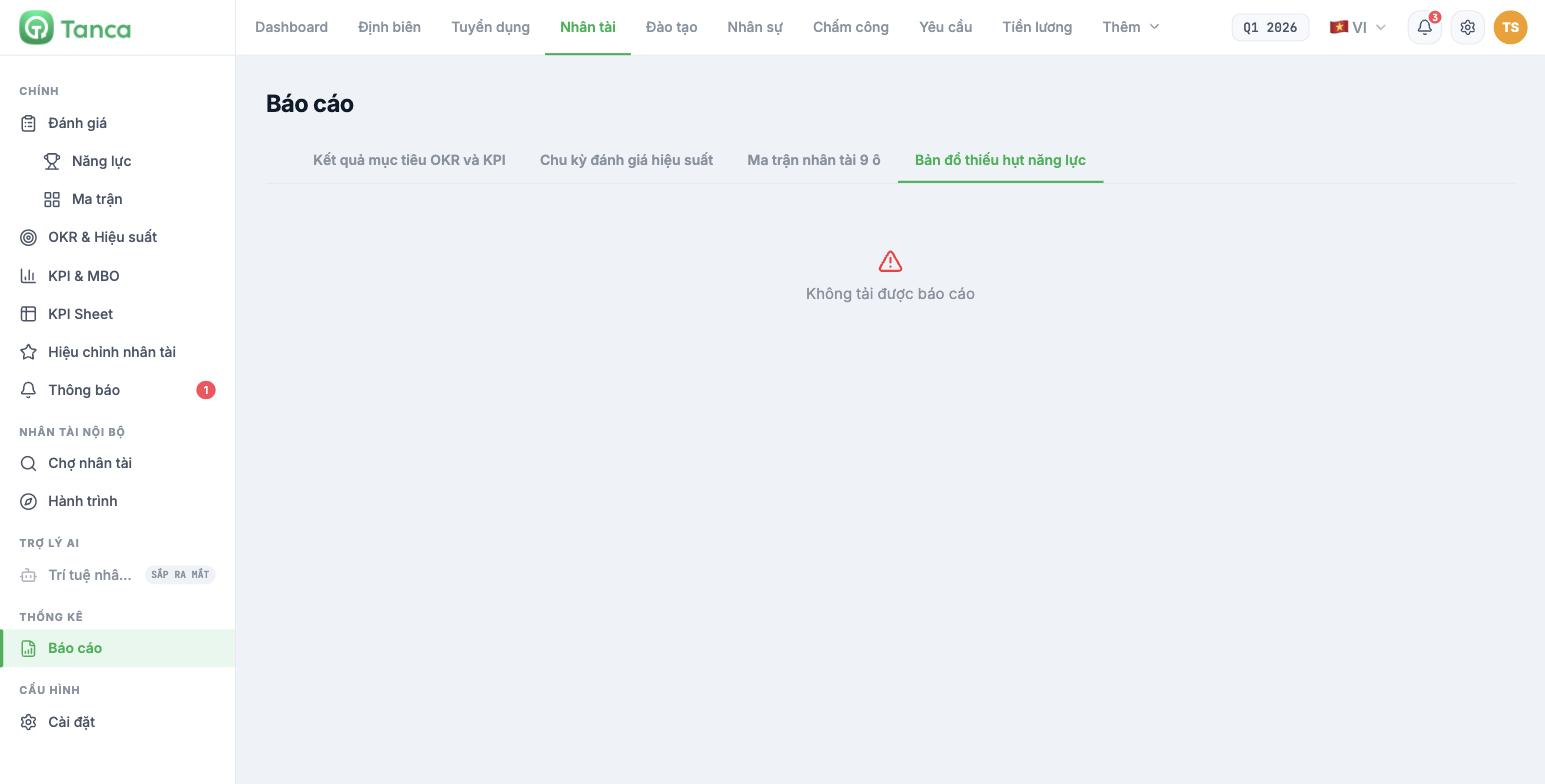
Go to Talent › Reports. The page has four report groups:
| Group | Content |
|---|---|
| OKR and KPI Goal Results | Goal results |
| Performance Review Cycles | Progress of review cycles |
| 9-Box Talent Matrix | Company-wide nine-box distribution |
| Competency Gap Map | Competency gaps — the report covered in this article |
None of the four reports currently load. Every tab shows "Unable to load report". This has been logged for the product team to resolve. Until it's fixed, use the manual method below.
What to do while the reports aren't working
- Go to Talent › Reviews › Competencies › Reviews tab.
- Click Export File to export the cycle's data to Excel.
- In Excel, add a column `gap = required level − actual level` for each skill of each person.
- Filter rows with a gap ≥ 1 and sort in descending order.
- Group by skill to see which skills the whole company is lacking.
Step 5 is the step that produces the most valuable decisions. For a skill that ten people all lack, running one shared training course is much cheaper than coaching each person — and that's information you only see when grouping by skill instead of by person.
Three ways to use the results
| Purpose | How to use it |
|---|---|
| Annual training planning | Group gaps by skill and choose the five to seven most-lacking skills as training programs |
| Individual development plans | For each person, take the two skills with the largest gaps as goals for the next cycle |
| Deciding whether to hire or train | For skills the whole company lacks that are hard to train, hire externally; for small gaps that are easy to learn, train |
Don't put every gap into one person's development plan. Two goals per cycle is the realistic limit; any more and none of them get done.
When the numbers look unreasonable
| Symptom | Common cause |
|---|---|
| The whole company falls short in every skill | Required levels are set too high — review article B13-05; don't set level 5 |
| Almost no one falls short in anything | Required levels are set too low, or raters are too lenient |
| One department is far off from the others | That department's raters use a different yardstick. A calibration session is needed (article B13-08) |
| No figures at all | No review cycle has been published yet |

