A career path is the answer to the question every employee asks in their job interview and in their reviews: "where can I go from this position?".
Career path chart
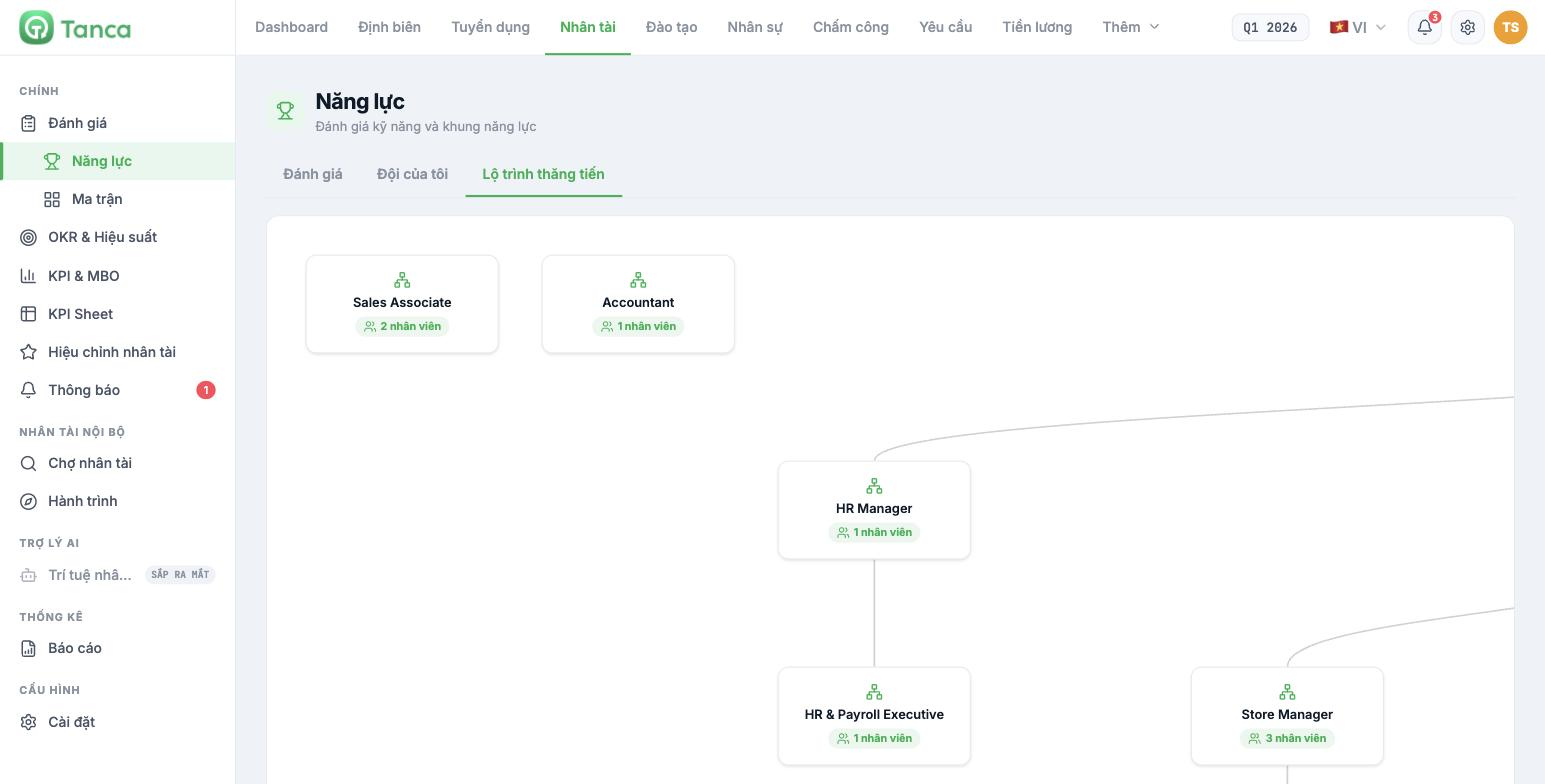
Go to Talent › Reviews › Competencies and select the Career Path tab. The screen shows a chart of job titles connected by superior–subordinate relationships, with each node showing the job title name and the number of employees currently holding that job title.
This chart comes directly from the business's job title tree, and is not set up separately here. To change a career path, you have to edit the job title tree in the business configuration. This screen is for viewing, not for building.
Three things you can read from the chart
| Observation | Meaning |
|---|---|
| A node with a large number of employees | A heavily staffed level — usually the entry level of the path |
| A node with 1 employee | A unique position. If it's a key position, this is a succession risk (article B13-11) |
| A node not connected to the tree | An orphaned job title — usually a data error, see below |
Check for job titles with duplicate names before using this chart with the board of directors. The business's job title tree may contain two records with the same name — for example Sales Associate appearing twice with different employee counts, one node inside the tree and one standing apart. This is a leftover from the initial data import, and it distorts both headcount and career paths. Merge or delete the duplicate first, then present the chart.
Building meaningful career paths
- Review the job title tree: delete job titles that no one holds and have no hiring plans in the next 12 months.
- Merge job titles with duplicate names.
- Check that each job title has exactly one direct superior.
- For each job title, make sure a competency framework exists (article B13-04) — without a framework, a career path is just a name.
- Reopen the chart and read it from the bottom up: where people enter, and how they progress.
A career path is only useful when each level has its own competency framework. Then the answer for employees is no longer "keep working hard and you'll be considered" but "the next level requires these six skills at this level; you currently meet four and are missing two".
Using career paths in three situations
| Situation | How to use it |
|---|---|
| Competency review meeting | Open the framework for the next level and point out exactly the two missing skills |
| Recruitment interview | Show candidates the real career path instead of making vague promises |
| Someone resigning because they "don't see a path to grow" | This is the only concrete information you have to retain them |
Don't draw a career path that looks better than reality. If the next level has only one spot and the person holding it has no intention of leaving, say so plainly and offer lateral development instead of promising a spot that doesn't exist.

